Friday, February 25, 2011

Guizhou - The road less traveled in China - Chapter 2 of 9

We checked into Shiyou Binguan in Yingpan DongLu which was nearby to the CITS office. The hotel was old and musty. We had a room with twin beds and an attached shower room for 80RMB. There was no hot shower but we could ask for hot water to pour into the little bucket in the shower room. The dirty bathroom had a broken vent glass, hence it was really nasty and cold during shower time. The dim light in the cold night made me a little uncomfortable. Our beds were equipped with electric blankets. But since I never tried one in my life, I feared I would be electrocuted! Considering the fact that we were sleeping for the night , we did not want to spend time searching for a better hotel. We dropped our luggages and turned on the electric blankets before rushing to meet a Miao lady who was awaiting us at the lobby.

I have forgotten the lady's name. She and her husband had a vast collection of old minorities’ textiles, needle works and handicrafts stored in their 4-storey home in Kaili. It is not unusual in many parts of China for business to be operated from home. They typically have contacts with many freelance agents who bring customers to them. Take note of ladies around town, bus and train stations with business card. They will try to coax you for a visit to see the minorities’ crafts in Guizhou.

Her house was only 15 minutes' walk from our hotel. But we decided to stop at a restaurant for dinner before heading to her place. I still remember the tomato egg soup we had in the cold night. It was a delicious meal in the cold winter.

The 4-storey house was narrow and sandwiched in between other similar buildings. Her husband was out sourcing in the far villages. She led us upstairs to a big room full of the minorities’ handicrafts. Most of her collection are from Guizhou and nearby provinces. We were mesmerized! Suddenly excitement overtook exhaustion! So many precious woven textiles, embroideries, minorities costumes, silverwares and baskets scattered around the room - on the shelves, cabinets, tables, hanging on the walls and in boxes on the floor. We could not take our gaze off  the beauty before us, as our hands were busy feeling the texture of the materials.  I recognized some of the fabrics, but many of the items looked fresh to me. We asked for a look of the minorities’ shoes and she led us to a different room. Gosh, it was another room full of collection! We were interested to buy but were drawn back by her steep prices. We felt like the fat meat on the chopping board!  While I don't claim to be an expert, I know what I was doing. But since we had taken so much of her time, we bought two pieces of old embroideries as a gesture of good will. It was expensive but I guess it was the price worth paying for a fruitful and educational experience.

We jumped straight onto our warmed bed as soon as we were back in the hotel room. It is unusual for people who come from tropical countries to take shower once a day. However, we were too tired to take a shower before bed and the cold water was not very inviting...

Thursday, February 17, 2011

Guizhou -The road less traveled in China (chapter 1 of 9)


Guizhou Province ( marked in blue ) located in South of China
 
After many trips to Thailand, Vietnam and Yunan, China, in search of the people of the Golden Triangle, my sister and I decided to take a trip to the off beaten track in Southeast of Guizhou Province in China - the hub of Miao and Dong people. In Vietnam and Thailand the Miao is regarded as Hmong. The diversity of Miao in China is far greater than in Vietnam and are so as the many minority festivals.

We did our homework online and through traveling guidebooks before we took on this less traveled route in China. I love to prepare well for my trip. Having some background knowledge of the destination helps to make me more observant and learn to appreciate simple discoveries along the trip. Guizhou is unlike other popular travel destinations in China, where anyone could easily book and join a local tour. Organized private tours or wonder around on your own are your only options. For those who don't speak Chinese, an adventurous spirit is required to travel on your own!

There are six airports in Guizhou . Longdongbao International Airport in Guiyang is the only international airport in this province. But very few international flights land in this airport. For international travelers who intended to travel by air to Guizhou, an interchange of domestic airline is required. It has fewer foreign tourists and is unpopular for domestic tourists. Thus, a proper plan is advisable if those who have a big objective to achieve in limited time of for traveling - just like us.


We decided to focus on the Southeast of Guizhou Province for the trip we took in February 28 -March 6 2008. I contacted the CITS of Southeast Guizhou via email after viewing its’ website. CITS is China large state owned key enterprises group integrating all inclusive service in travel industry. The highly acclaimed tour operator, Mr. Billy Zhang, a Miao himself was attentive and efficient in responding to my enquiries. We found him a very helpful person because he provides information even to people who do not book tours with him. He is knowledgeable and had served as guide to VIP and academic visitors to Southeast of Guizhou Province for many times. Communication with him was a breeze as he is well versed in English, both in written and spoken. As I do not know how to typeset in Chinese, all our correspondence emails were in English. He drafted a travel plan for us based on our interest and days available for travel. Our objective was to meet the ethnic minorities at their villages, to purchase the traditional textiles and to track around the region.

We flew into Guangzhou Baiyun International Airport with AirAsia (Malaysian budget airline), as it is a key airport in China with many domestic flights connections. It is the shortest distance to travel from Kuala Lumpur to China's major airports. Upon arrival (very early in the morning) , we immediately went around to scout for the best deal for flights to  Guiyang - the provincial capital city of Guizhou. In China, generally air tickets are being sold at a cheaper price when the flying dates are closer. It is totally opposite comparing the ticketing systems in Malaysian airlines and airlines of other countries. As long as you do not travel during peak season, it is not difficult to obtain the same day or next day tickets. You can even bargain for a better price. We found a great deal of 60% off the regular air ticket price for a next day flight to Guiyang, but we topped the deal with an extra 5% off because we purchased two tickets. 65% off the regular ticket price! I love the bargain culture in China! I couldn't remember which airline we took but it was not a budget airline and the service was not bad.

My sister and I checked into the Guangzhou International Youth Hostel for a night stay in Guangzhou city. We had a day of leisure in Guangzhou before our trip to Guiyang the next day.

Guiyang is only a stop over because it is closest to Kaili, where we will meet Mr. Billy Zhang and where we will begin our exploration.  Kaili is located in southeast of Guizhou - the Qiandongnan Miao & Dong Autonomous Prefecture. Upon arrival in Guiyang, we took a cab to Tiyu Bus Station on JiefangLu which has more frequent bus services to  Kaili. We were in a rush for our meeting with the tour operator, Billy before his office closes by 5pm. We estimated our arrival at 6pm, so we called to ask him to wait for us and he did. The two and a half hours bus ride was pleasant but we were worried about our delay. The moment we arrived, we jumped out from the bus and immediately asked for direction to the CITS office. We were told that it was not too far from where we were, so we started to walk and at times, ran with our backpacks for 20 minutes. The sky was almost dark when we finally arrived at the CITS office. However, Billy waited for us patiently. It was a relief to let go of our lugages and cleared our bladders after the long ride and walk. :-)

We finalized the tour details and price with Billy. We had a private car (locally made car as classy as Toyota Camry) and a personal driver but not a guide. There was additional charge for having a guide and since both of are well versed with Mandarin, we headed on without guide. Our four days three nights trip cost us 2,600 RMB excluding meals and accommadations. It was a great deal comparing with the private tours packages on other travel agencies we found the web.

Our itinerary was as follows :

Day 1 - Depart Kaili , a short visit to a Gejia batik making showroom
           - Visit Langde Miao village -Visit Ta Dang Miao village
           - Stopped over Yong Le town for lunch - Visit Danjiang town market &
              Tashi town market - Explored to Zairong Miao Village
           - Dinner & overnight in Rongjiang Town

Day 2 - Visit Rongjiang morning market -Visit Congjiang county Yin Than Dong village
           - Conjiang county Basha Village - Overnight in Zhaoxing Dong village

Day 3 - An hour hiking nearby village of Zhaoxing village and explored to town
           -Lunch in Rongjiang Town- Visit Yong Ping Market - Visit Shandu Shui Village
           - Overnight in Shandu town

Day 4 - Depart Shandu, passing Danzhai - Visit Shiqiao paper making village
           - Visit Qingman Shortskirt Miao Village - Back to Kaili

As a scholar himself, Mr. Billy Zhang not only provided us the trip plan but also shared with us a little about the Miao culture in the region. It was a pleasant meeting. He further introduced a local trader to us when we expressed our interest in purchasing some needle works of the ethnic minority people. I could tell that he was sincere in helping us and his people, the ethnic minority, rather than for the sake of earning commission. We are more than agreeable to the quote of CITS Kailli
" Travel with CITS in Kaili, we offer you the best service".

Sunday, January 30, 2011

recycled and refashioned - Children skirt

 
Before

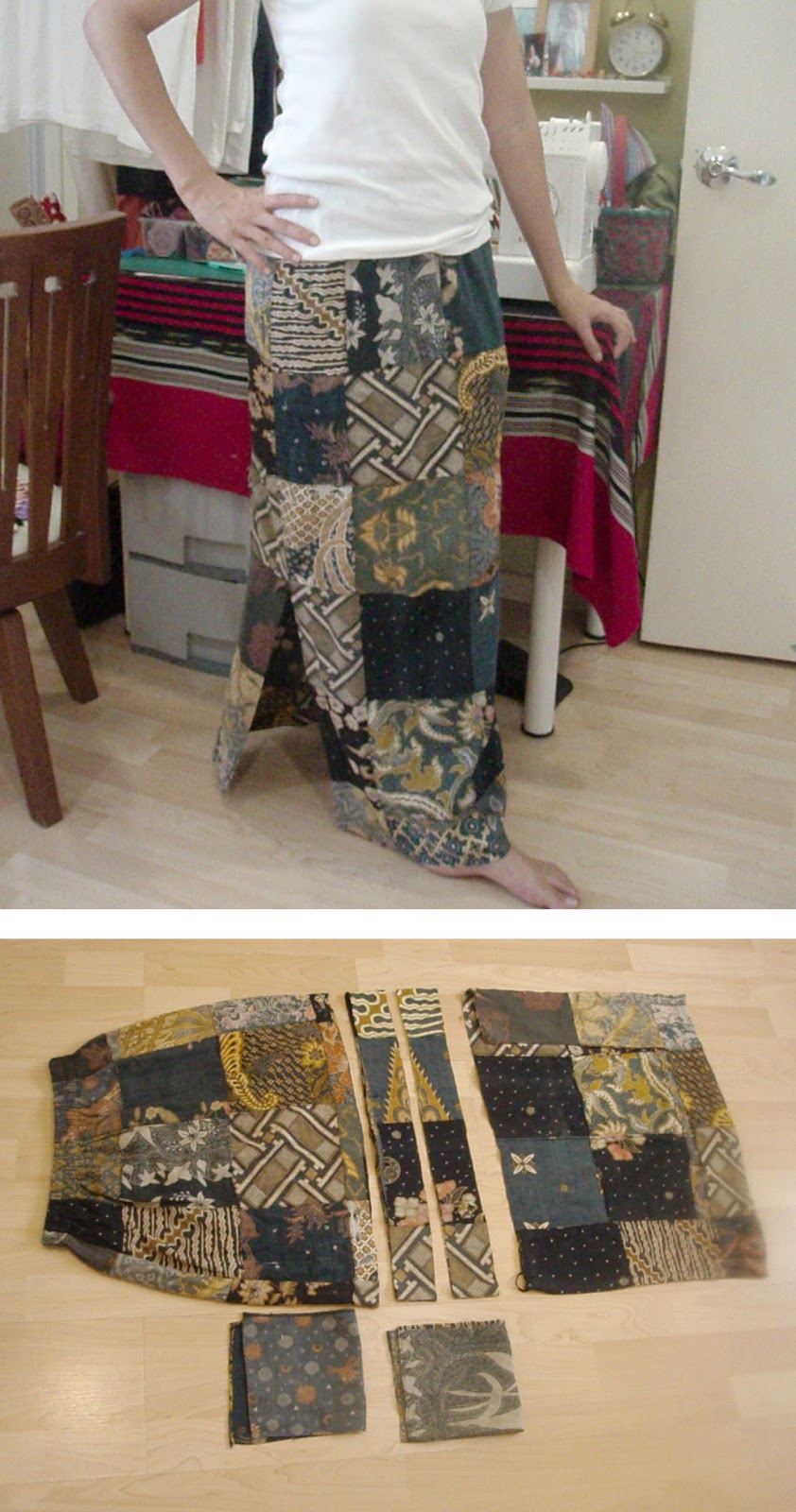
I love batiks. I found all of them unique regardless of their origin. I realised they are distinctive and beautiful in their very own forms. I have a skirt made with beautiful patched old batik Solo. The problem of seasoned fabric is they do not last long as the fabric is somewhat fragile. I had mended a few tears and continued to use it for short while before a bad rip developed on the skirt and I had to give up wearing it.

As usual, I kept it at a corner for awhile. Until one day, I took it out and decided to transform it into a skirt with crossed straps for my daughter. The bad rip was at the bottom part of the skirt and I trimmed it off to make it into an A-lined knee length skirt.

I love pockets and I thought with the crossed straps, the skirt would look cute. I cut the fabric as shown on the picture on the right. The top part of the skirt was cut into the length right on my daughter's knee; the two bands for the straps; from the bottom part of the skirt, I cut off some fabric for the pockets. It was a quick job as there were only minor adjustments.


After


My old torn skirt was given a new life. Zen looks just great in it!

Wednesday, January 12, 2011

Little Artists of Sapa


Standing in front - Anh , Back - Chi

I met Anh aged 10 and Chi aged 13 at Sapa town, Northern Vietnam in 2009. When my friends and I were looking for a cafe to take a rest, I met two Hmong girls dressed in factory-made Hmong costumes with elaborate machine stitched laces by the walkway. They were not the usual Black Hmong but probably white Hmong from or around Tamduong.

They came to a shop front with a narrow platform. Anh took out her lined exercise book from her sling bag and started drawing with her blue ball pen. She used the platform as her table as the shop was built on the slope that was raised above the road. I was attracted by them, especially Anh who was so engrossed with her drawing. Being an artist myself, I always get attracted to kids' natural talent to draw and paint. I gave her the remaining box of crayons which my friend Pam had prepared to give away on the trip. We would usually bring along gifts for children on our travelling and it was a joy to see Anh and Chi so jubilant with having added crayons.

Anh happily filling in colors on her drawing

While my two friends, Pam and Subra, were having beer, I found pleasure in spending time with the girls. Anh was able to converse in simple English and both of them could write their names in English. I believe that they learnt English in school. Anh was confident and wise beyond her years. If she is given opportunity in learning, she could have great achievement in future.

The two paintings given to me by Anh & Chi

I drew a drawing for her and they each drew a painting for me. Anh also gave Pam and another tourist each a painting. I was touched by her generousity. I treasure the two drawings very much and I hope to see them again when I visit their homewon again.

Tuesday, January 4, 2011

Handmade Notebook

I love notebooks and especially those with fabric covers. I use them as travel journals. I would record my experience from trip planning, during the trip and after the journey.

I made two notebooks not too long ago...or more correctly last year since today is January 1, 2011. I took a study of the construction of notebook with fabric cover before I customized my notebooks in my own designs. The toughest part of the process was stitching up the papers. It requires lots of patient and time to accomplish the process.

I have been working a lot with fabrics made by the ethnic minority people of the Golden Triangle and China. For a change, I decided to use Malaysian batik with Borneo ikat motives for my first notebook. I will try to write Chinese in these tiny little squares....


With the snap button, the notebook could hold extra materials, such as brochures.

Right after the first notebook was completed, I couldn't wait to make my second notebook. I decided on an Oriental Theme for my second attempt. I got the idea from a Chinese brass frame hook in my drawer. The hook was in shiny gold when it was new. Over the years, it tarnished and looks even prettier now. The brass frame hook will served as a lock for the notebook. It will be attached onto the magnets hidden beneath the red fabric on the cover of my notebook.

The red cloth I used to make the notebook shown below was given by a friend who runs a business of curtain making and upholstery. I was fortunate to collect fabric remnants from his workshop for free! I made a reversible tote bag and another notebook with the same material.

Front View                                                              Back View

I ran the geometry patterns on the fabric with a sewing machine. Then I stick two small magnets onto a cardboard, which will be used as the front cover of the notebook, before I glued the red fabric on it. Prong snap buttons were used to secure the red band that holds the metal hook. I used white glue and double sided tape for this project.


Left: A Chinese fabric being stitched onto paper.  Right : Plain paper for the insert.


It was a 2 day project which can be done over the weekend. I just can't wait to use the oriental theme notebook for coming trip to China!

Sunday, December 19, 2010

Ethnic Cushion Covers


My favourite silk cushion cover with old Miao embroidery


Three years ago, I designed a series of ethnic fabric cushion covers for the little stall I ran with my sister. The cushion covers are made with my collection of ethnic minority tapestry. Some sewing were done by myself and some were sent to a friend's workshop. These cushion covers were made with limited production of single, a pair or double pairs of different shades. Honestly, I did it for fun more than for the business. I just love to create with my collection of ethnic fabric and accessories. (Don't get me wrong, I do need income). However, I just cannot make any profit considering the amount of time spent in producing every single design.

I am glad that I kept some of the cushions for personal use. Some of these ethnic tapestries I used are difficult to obtain these days and they cost double or triple than the price I paid. My favourite design shown above was sewn from a Cambodian silk scarf with a Miao embroidery piece from a village in Quizhou, China. This little piece of embroidery is really precious. It took me one international flight, a domestic flight, a long distance bus and a chartered car service to reach the village. Of course, there is an easy way to get these pieces from shops in the city of China. But, be prepared to pay 10 times the price and no fun for not able to have personal encounter with the people who produced these beautiful handicraft.

2-tone artificial silk covers with old Thai silk yoyos and pompons-
zip less design with the opening hide behind the decorative band


2-tone artificial silk covers with Vietnam White Hmong embroidery and pompons
 
Cushions with Flower Hmong tapestries and decorated with bells and Tay people accessories

The piece of cross stitched embroidery and applique is part of a Vietnam Flower Hmong lady skirt

Cushion cum chair pad covers with Vietnam Flower Hmong people embroidery
-The embroidery  was part of Hmong women sleeves


These two Thai raw silk cushion covers show the ethnic flavours with their decorative pompons lace and embroidery

Cushion cover with Vietnam Lu people embroidery
-The embroidery  was part of Lu women sarong


I felt sad when the pair of cushion covers, as displayed above, and another set of the same design in brown fabric were sold. In addition, I was feeling happy when my little stall had closed sale. I guess I was running my passion rather than my business!

I had so much joy when my sister and I were running our little business. With the business running, I had a good reason to travel for business, a good excuse to spend time on my creations, and escape from the frequent questioning from my husband for not working on my paintings.

Tuesday, December 7, 2010

Handmade Cards

Recently I received my orders from Joann.com  and Amazon.com. I was so happy and excited like children getting their new toys. There were my scrapbooking materials, fabrics and books. I just couldn't wait to start new crafting and sewing projects. It was tormenting for not having time to create with holidays and happenings around. After 10 days of long wait, I finally settled down to create.

With my beloved Aunt Choo Choo's birthday around the corner, I made her a card. No sketch, just playing around with my new puncher and stamps. The velvet ribbon and metal alphabet used on the card exudes class and elegance.

Time To Celebrate I
And I made a few more cards to keep for birthdays of family members and close friends.

Make A Wish


Time To Celebrate II
You light up a room

I still prefer hard copy birthday cards than e-cards where I can touch, feel the textures and read the hand written messages. Thus, I like to take the effort to handmade them for those who are dear to me. Something I had done since my high school days. When beautiful imported Hallmark cards were too expensive for me to afford them. My simple cards of drawings with watercolour on water color papers had warmed and touched hearts.

Today, with the availability of modern tools and art supplies, more beautiful and fancier cards can be made easily. My daughters continue the good tradition. They make me all kinds of cards, including one from Ning called the "Happy Day card"  :)

Friday, December 3, 2010

Journey of Northwest Loop Vietnam-Chapter 4

"I know you what you did behind my back."
It was entirely different to see Dien Bien Phu during the day and night. It was a hazy morning when my sister and I got up. Probably due to open burning for land clearing. My sister and I had a simple breakfast and checked out of the guesthouse. 

Our first visit was to the morning market. Where else could be as fun and interesting than the local market. It was here, I met with many Hmong people apart from the majority Tai people.

Red Hmong baby carrier
The hill tribes spend lots of time in producing baby carriers. The baby carrier is a work of art and love. As much as I love to own many styles of baby carriers, I only own two of the carriers from Dong people in China. I am skeptical of buying them from the haunting experience I had in collecting old stuffs and personal experience shared by my sister's friend. Most of the time, I would just admire them... like when I came across this Red Hmong mother and child in a baby carrier at the market area.

"Yau Cha Kuih"                                                                Beautiful girl vs ugly fish

Pleasant encounter
There was a lady in the market selling a deep fried cakes , similar to Chinese " Yau Cha Kuih". But I have no guts to try as I would be on the road and I didn't want to take the risk of an upset stomach. And the small fresh water fish looked so non appetising. I am not a fan of fresh water fish.

Young embroiderers
After leaving the market, we headed north to Lai Chau Province. On entering the province we could feel the rising of temperature though it is situated on high mountainous region. On the way, we stopped at a Red Hmong village. That was my first experience coming close in contact with the Red Hmong. We communicated with sign language and friendly smiles. 

In the village, I met a beautiful young girl sitting in the porch embroidering her new outfit. It was a beautiful scene. I approached her to see what she was working on. Although she was shy, but she was friendly. Two young girls came later to join her for the sewing session. I am amazed with their patience and skill at this tender years. 

Cool head cloths and looks
Our journey continued, and we passed by a town where I had a new encounter with tribe I have never met before. These ladies were cool and calm. I don't think they are Hmongs as Hmongs do not use such head cloths. I bought some machine embroidered laces where the tribe used to decorate their outfits in a small shop. The price was reasonable, and they did not overcharge us though we were tourists. I think generally, people in the rural are still genuine and honest.

We crossed the a bridge which I had forgotten its name ; passing by mountains and we descended to a deep verdant valley where Lai Chau town is nested. It was a hazy and dusty town which has the oddity of being one of the hottest places in Vietnam in the summer. Our driver stopped us for lunch at a restaurant cum guesthouse where we met with two French bikers with their Vietnamese tour guide. How I envy them to be able to travel the country on bikes.

Haah, 50,000 Dong?                                                              Funky girls hat

Followed on was Tam Duoang. We had a close encounter with the friendly Black Dao. There was a big group of them harassing a foreign biker with his tour guide to buy their goods. 

We jokingly told them that it was our turn for the pleasant harassment. We found the Black Daos to be fun loving people. Besides weaving, they handmade their beads in black, white and red. Making beads is uncommon for the hill tribes in this region.

Meeting a group of Lu ladies in Tamdoung was another highlight of the trip. Their "black teeth" made them distinctive and charming. The Lu women smoke their teeth through a bamboo pipe by burning Met and Xuyen trees they obtain from the forest. The Lu sometimes walked all day to Sapa to sell their sewing products. Meeting them in Sapa is really by chance. 

We passed the infamous Tram Tom Pass in Tamduong and were overwhelmed by sublime beauty and serenity of this mountainous area. The creator is truly the most talented architect and artist and I witnessed another of His fabulous creation here.

The ride from Lai Chau to Sapa was really bumpy on the earth road. I am glad that I had no motion sickness or I would have thrown out the overnight meal. The excitement of meeting different tribes along the journey had erased all horrendous memories of the unpleasant ride. Our 2 days ride with our jeep ended in Sapa.


This is final chapter of my sharing on travelling experience via the Northwest loop, Vietnam. Thank you for following.

Friday, November 12, 2010

Recycled Travel Journal

I love to bring along a journal on my travelling trip abroad. I am ashamed to say, I never completed any of them when my journey ended. Reason being, I was simply too tired or busy to write during the journey. After all these years, I have completed only one journal on my Beijing visit and that was done after coming back home. I only have notes of the rest which I used for references on whenever necessary.

My Chiangmai Travel Journal

For my recent trip to Chiangmai with my good friend, I handmade a recycled travel journal with old table calendar. I always thought it would be too wasteful to trash the outdated table calendars and I have kept few copies of them in my treasure box :)

Materials

As the main concept for this journal is " Recycled", I picked a Body Shop ribbon from a Christmas gift packaging last year, some garment tags, old drawings on watercolor paper, old paper stocks which had turned yellow and spotty and most important an outdated table calendar for the project. I gather some materials and info of Thailand from an old magazine; color copy a fabric I bought from Chiangmai years ago; select some plain paper and pretty scrap booking papers from my paper stash; rubber stamps and inks, some quotes on paper. Last but not lease, the stationery set which consisted of white craft glue, used hotel key card or phone card as glue applicator, various sizes double sided tapes, cutter, scissors, markers and pen.

1) First, cut away the calendar stand of rectangle shape. Then, flip one cardboard to the front and the other to back to make the front and back cover.

2) Tape the recycled ribbon on front and back cover with masking tape. To prevent ribbon from fraying, brush clear nail polish at the ends of ribbon.

3) Cut and tear small pieces of plain, printed papers (even fabric) and images or words from catalogues and magazine related to the theme. You may tear and cut the papers during the process of the collage.

4) Apply white craft glue with a used hotel key card on the cover. I worked on the front and back cover at the same time in order to achieve similar color tone and texture. I started the paper collage by pasting different papers of varied sizes overlapping each other, stamping some beautiful images and overlapping with some semi transparent paper. These layering gave a depth to the artwork and making the layout more interesting. Don't worry if the papers go out of the borders as you could trim them later. Also not to worry of too much glue as white craft glue is transparent once it dries and leaves a protection coat on the crafts.

Half finished

5) Brush some colors on the covers with ink pad to make the colors of the puzzles more uniform. Then, I used a permanent marker to draw some patterns in order to link all the puzzles together. I continued by brushing over the black drawing with white acrylic paint as I didn't have white ink pad; the drawing now blends with the artwork.

6) I pressed some acrylic crystal stick-on with an iron. You may obtain this crystal beads from shops selling tailoring supplies where they are greatly used locally on Malay tudung and baju kurung. Or you may recycle you broken accessories parts to collage onto the covers.

The making of travel journal
A fully completed journal
The cover and back cover of my travel journal is completed. I went on working on the inside pages. I tore some plain papers to cover on the calendar pages for writing spaces; brushed some paint over garment tag; cut a strip of paper from an old catalogue to paste on one of the page; using my magic ink pads to brush on the edges of paper and etc. I enjoyed most was machine stitching on the book.

Left : Machine stitched a flyer onto the page- allows full view of flyer including the back page.
Right : A hill tribe embroidery work was stitched on a paper before being paste onto the inside cover

I didn't complete the journal writing again.....and of course those photos had to be added on after coming home. A week of hard work after coming home . Yeah!!!I finally completed my first handmade travel journal and putting it onto my blog. Good job!

Glimpse of the inside pages

So friends, let's start making a recycled journal for yourself. It doesn't have to be perfect like those publication layouts. Be free to doodle something and paste on anything. Writing down feelings and thoughts of a moment and cherishing your record for a lifetime can be unique experience.

Sunday, October 31, 2010

Journey of Northwest Loop Vietnam-Chapter 3

Turned and I got you.
On our journey to Dien Bien Phu, just before Tuan Giao, we came across some Tay children walking home from school. While our children carry fancy bags with Ben Ten, Barbie or Disney cartoons, they used colorful hand woven sling bags with enduring beauty that never go out of a fashion. (At least that is my opinion). These types of bags are commonly used in Indochina with variation in motifs and colors. 

Let's try this.
Sa People-Life must be hard, smile was luxury.
I always bring along used children's clothes and toys when I travel to Northern Vietnam.  By the roadside near to a Tay village, we stopped the jeep when we spotted a woman with her naked child. I gave her child some old clothes. Very soon, more children and adults rushed down from their stilt houses at the slope next to the road to get their shares. Some distance away, we met one of the poorest tribes in Vietnam, the Sa people. They were small in size and worn shabby clothes. They wore modern clothing and the ladies were clad in Sarongs. We distributed some candies and clothes to the kids. 

At times, I felt reluctant to give away used fashionable children's clothes as I worried this might affect them from keeping their traditional attires. But when I saw those children didn't have enough clothings to keep them warm or having enough change of clothes, I added in the extra load to my backpack. Their mothers couldn't make sufficient clothes for them as their costumes take longer time to produce and kids need frequent change of clothes. 

In Tandem

bundles of spun cotton
Our jeep had a flat tyre when we were at the town of Tuan Giao. Luckily for us, we got to roam the town and meet the locals while our driver changed the tyre and had the flat tyre repaired in a nearby workshop. I bought two bundles of embroidery spun cotton and some beautiful laces where the hill tribes used to decorate their costumes, etc. These laces are being extensively used by hill tribes from Thailand, Vietnam and China and the choices 
Black Tay
here were better than the city in Hanoi or Ho Chi Minh City in Vietnam. The prices were cheaper than the ones in the city. Another thing I did in this town was to follow the ladies like a puppy, admiring their intricate embroideries or beautifully woven textiles closely. The Tay ladies that I have met along the Northwest loop Vietnam mostly appeared in neatly tied hair buns or head cloths; dressed in tightly fitted and well coordinated outfits. These ladies in rural areas really took care of their appearances.

Am I cool?
The flat tyre of our jeep was fast being replaced. Our journey continued after the short break. Before arriving Dien Bien Phu where we would spend the night, we came across the coolest girl we ever met in Northern Vietnam. I am not sure if that was a common hairstyle for the local kids but it was the same hairstyle we found in old Chinese paintings and porcelains.

We arrived Dien Bien Phu town before it turned dark.  Dien Bien Phu attracts many French tourists for it was where the French last colonialism in Indochina ended with its defeat to the Viet Minh. As our trip was short and our main purpose for this trip was to meet the locals, we didn't visit the relics left for this decisive battlefield.

DIEN BIEN PHU HA NOI HOTEL - the guest house that we put up was really big. This jointly operated guesthouse between Dien Bien Phu Tourism Ltd. Co and Ha Noi tourist was pleasant (to our standard) and we paid about US$12 for double bed with attached bathroom, hot shower and buffet breakfast.  In the town, there was photo shop where we could copy our pictures into CD and a young man in the shop was adept in Adobe Photoshop programme. He adjusted my photos in his computer to their best quality before developing them! The people here might not speak English, but they were amiable and helpful.

We had a good sleep in Dien Bien Phu after the long journey.

P/S: to be continued in chapter 4