Saturday, September 24, 2011

Hand Sewn Journals


The on going major renovations in my new home and the never ending household chores had kept me away from posting for months! Now, with the little time I allocate for myself, I am pleased to share with you my creation completed months ago- 3 handmade journals.

A friend taught me this sewing method where she learnt during working with an NGO in Nepal. I love the spine design very much.

I began making the very first journal during my visit to the Great Cold Mountain of China, home to the minority of Yi people (or formerly known as Nosu). Hence, the very first journal was naturally inspired by the beautiful fabric cuttings of the Yi people.

Very Zakka. Love it!

These fabric cuttings were from the hands of a lovely Yi crafter who worked in a sewing centre in a vocational school. The Yi people sew these fabric patterns on their traditional clothing, bags and etc with a yarn running along the edges to prevent fraying. But I like the raw natural fraying edge. The brown paper, the canvas being used to wrap the journals covers, the laces on the spine and even the thread were bought in Chengdu wholesale market!

This journal was completed after coming back home. I planned to write my experience for the trip in The Great Cold Mountain and Chengdu.......but it is still quite plain (except from few messages left by friends I met there)

Right after the first journal, I made this notebook/journal shown below. I had a big harvest in Chengdu, China wholesale market of fabric including the ever charming blue & white batik used on this notebook. Again, I can not part with the Yi fabric cutting and have great fun machine stitched on paper.

The paste stenciled resist indigo dyed cotton from China as cover.

I continued to make the 3rd notebook/journal with much joy. The covers were wrapped with our local fabric- Terengganu batik of Malaysia. I thought of giving this to a friend for her coming graduation...but I still find hard to part with it.

Notebook with Malaysian batik covers.
There are many websites and blogs giving free tutorial on handmade books that you can refer to. Check this one out http://www.toggle.uk.com/journal/creating-hand-sewn-books/ You may purchase books from Amazon.com. or Kinokuniya bookstore in KLCC (Malaysia). Or grab one notebook at home to figure out how to make one!

Tuesday, April 12, 2011

Bu Wa Wa - Dolls

Not too long ago, I came across a lovely doll that was designed in a simple but nevertheless interesting technique during my visit to a couple's home . The doll was on displayed in my friends' washroom together with some other lovely decorations. When I visited them again early this year, I decided to take a closer look and study the construction of the doll. Obviously, I was not able to contain myself from the investigation!

Chinese Wa Wa

However, I totally forgot about the idea of making the doll until the recent 2011 Chinese New Year. I was making some bunnies in conjunction with the year of Rabbit to give away as gifts to friends, as well as using some as the seasonal decoration at my lovely home. The idea of the doll flashed back in my mind when I was making those bunnies. So, I decided to try it out. I sewed the first prototype, as shown in the picture below first from the right. My daughter, Ning simply adores it and rocks the doll in her palm. The second doll as shown in the picture above was sewed with a vibrant red fabric - to welcome the auspicious Lunar year! Look at her, she seems to sleep soundly on the woven basket. 


I later discovered that the dolls I made are different from my friends as her doll comes in two parts. I am happy to have my own version of beanie doll.


Wa Wa Family

I name these dolls "Wa Wa". "Wa Wa" means doll, but it is also commonly used to refer to little girl, in Chinese. My “Wa Wa” is made with fabric in a circle, just like the fabric used to wrap a baby. I filled the round fabric with beans and cotton/ synthetic fibers. The head of the doll is made with smaller circle fabrics and filled with fibers too; it is then stuffed onto the opening of the larger ball that makes the body of the “Wa Wa”. I drew the face with acrylic paint to give my “Wa Wa” a finishing touch of “life”. I also added lavender potpourri into some of them for the soothing fragrance.

Conference
Looking at these "Wa Wa", the Chinese children song " Ni Wa Wa" keeps playing in my mind.

"Ni Wa Wa, Ni Wa Wa, Yi Ge Ni Wa Wa......"  
 no no, it should be   

" Bu Wa Wa, Bu Wa Wa, Yi Ge Ni Wa Wa......"  
 "Bu" in Mandarin means fabric, hence, “Bu Wa Wa” means doll made with fabric.

Friday, April 8, 2011

Guizhou- The road less traveled in China (chapter 5 of 9)

Day 2 part a - Southeastern Guizhou
 
Ronjiang Hotel


We were delighted to wake up in the morning to the serenity around Ronjiang Hotel. The hotel was secluded as it was located far from the main road and and surrounded by a private garden. Nevertheless, we discovered a different world outside the hotel when we walked to the main road after our breakfast. The streets were bustling with people and activities!


Middle - Appetizing "Jiaozi"
Right - The people here had sweet tooth
Although the steaming food seems pretty appetizing to us, we could only share a bowl of red bean soup as we were still full from the heavy breakfast. We spotted a hair salon on the main street and decided that we could have a good hair wash.....


Cool ladies! With a twist, one can turn to be a new fashion icon in the city.


Yummy!
Mandarin oranges
The market was just within walking distance from our hotel. Our driver were waiting at the hotel while we explored the market. It was fascinating to see the locals in their traditional clothing, hairstyles and speaking the local dialects which we didn't understand at all. We find pleasure in sampling the local snack and even bought some fresh vegetables that were later being cooked at the restaurant for lunch. We appeared to be the only tourists in this area and as we observed the locals, , we were being observed too.


Typical octagonal pagoda type drum tower located a the centre of Xiajiang Dong village. 


Dong girls
Without further delayed, we continue our journey to the southeast of Ronjiang. We drove passed beautiful landscapes and people along the way. After two hours of driving along the country sites, we reached the next highlight of our day - a visit to a Dong village, located 20km north of the county town Congjiang.

Yingtan Dong village  has existed since Qing Dynasty. It has a population of 1,700 people. According to the latest statistic, the total population of Dong people is 2,960,293. They are mainly distributed in the mountainous areas between the four provinces of Guizhou, Hunan, Guangxi and Hubei. The major residences for the Dongs are Southeastern Guizhou where Yingtan Dong village is located. They Dongs are known for their architecture, particularly their octagonal pagoda-type drum towers , wind and rain bridges that provide sheltering for people during bad weathers. The drum towers of Dongs were built without a single nail. They are the symbol of Dongs and served as a gathering place for the villages to discuss and settle important matters, hold important festivals or entertainments.

Warping the loom
The weather was getting warm and sunny in March 2008. It was a good time to carry on with various outdoor activities. We were thrilled to find many Dong ladies working together in village for the various processes of cloth making.  Some were busy spinning; 2 groups of ladies warping the looms which were extended as far as 70 feet from one end to another. The ladies were quite and attentive to their work as Dongs have taboos on speech during the weaving. For instance, they cannot use terms such as ‘broken’ and ‘disorder’, which they believe may cause the weaving to fail. ‘disorder’, which they believe may cause the weaving to fail. We felt that we have traveled back in time just by walking around the village. We were the two aliens who didn't fit in the picturesque scene. Although they are now connected to the modern world with infrastructures development, the people here remain to be living in their secluded world, except from the few antennas that stand out like sore thumbs.

Dong hand woven fabric. Close-up on the pattern.
We visited the only grocery store in the village and bought a roll of plain hand-woven textiles. This woven fabric would be dyed if I have not taken it under my possession. Though many of the minority
tribes use indigo plant to make their dyes, each tribe put their signature by adding different ingredients to the indigo dyes. The Dong women add lime water to indigo plants to make their dyestuff. The fabric went through repeated processes of dyes and washes up to three or four times before the color is deemed to be perfect. Next, persimmon peels and chestnut shells are pounded into liquid and mix with a kind of berry-Ardisia crenata. Again the cloth goes through another dying process to achieve a deep blue with radiant rosy accents. After drying, the cloth will be folded, coated with egg white and intermittently beaten with a wood mallet over the course of two weeks until the cloth shines. The final step is to starch the cloth with glue made from cattle skin, this process ensures durability and fade -resistant to the fabric. The brightness of the cloth varies, depending upon the duration of crafting and beating. The more it shines, the more precious the cloth is deemed to be.

Another interesting and environment friendly culture of Dong is that whenever a girl is born, her parents would plant tens up to hundred of fir saplings for their baby. When the child reaches the age of 18 and marries, the fir trees, that have matured too, are felled and used to build houses for the bride and groom or for sale. For this reason, such fir trees are called "18-year-trees."  So, it is no surprise to see many fir trees growing around the Dongs' villages.


We spent 1 1/2 hour roaming the village but it was a pity we didn't get to have much interaction with villagers. I wonder if a homestay is possible in this village. With a homestay, one can get to know the people and perhaps joining their fabric making process if that is permitted.

Wednesday, March 16, 2011

Guizhou- The road less traveled in China (chapter 4 of 9)

Day 1 part b - Southeastern Guizhou

After visiting Ta Tang Miao hamlet, our driver stopped by a restaurant in Yonglei town for Tyng and I to have lunch.  The restaurant had quite a presentable exterior but the interior appeared to be old and unkempt. The kitchen was the last place to visit for we needed a meal to fill our stomach. Anyway, we enjoyed the meal as we were famished.

Right : I fear to know the faith of the dog in the cage


On our way to Zairong village in Rongjiang county to visit the Pingyong Miao, we passed by another 2 towns - Danjiang and Tashi. We had little time for a walk at the markets and I came across some Miao accessories. I was unsure if there were made of silver but I bought them anyway.  Some of the smaller pieces ended up on the t-shirt range which I designed and made few years ago.

Left : Silver accessories for Miao costume


Little helpers
collecting logs
for burning
Our next itinerary was to visit Pingyong Miao people. A Miao subgroup mainly lives in the villages around Rongjiang who are good in making indigo dyed batik with beeswax. It was almost 6pm when our driver reached at the roadside to Zairong, a Pingyong Miao village we were visiting. The village was located at the valley where we descended steep slopes, passing through terraces on and going around the mountain trails before we reached the first home. We tracked on a moderately fast speed for nearly 15 minutes. So, when we spotted someone in the first house, we walked straight to it. A young girl was sitting at the veranda drawing her batik with wax. We had came to the right house! Another lady and a young man from the house came to greet us too. When we expressed our interest in their batik works, they brought out some of their finished works.

All the works were done on cotton head cloths measuring a 1 foot width and 12 feet length with motifs of bird, fish, butterfly,  figures, symbols of dragon and even an mythical animal named bird dragon. These works were done by the two sisters-in-law in the same family. The works were drawn with free flow and mastery of sheer skill. Yuan Ren Zhi, the daughter-in-law in the Loong family was a confident and skilled artist. She sketched her works by scraping the fabric with her finger tips before applying the wax, whereas, the young batik artist would trace the fabric with the stencils before applying the wax.


Left : 1st from left - Yuan Ren Zhi. Above: Tyng busy making selection


We picked four pieces of the work for a good deal. Three pieces of them were sold soon after we displayed them in our little booth after the trip. Tyng was smart to keep the 4th piece before it is taken up which ended none for me. It was nice to buy at first hand and meet the artisans. I regretted for not getting more then.

Our harvest -Guizhou Pingyong Miao head cloths

A boy from Pingyong
riding a wooden tricycle
The sun was setting. We had over spent the time given by our driver, Xiao Wu. We hurriedly left the Loong family without further exploring the village. We ran most of the way up to the road so as to race against the disappearing sunlight. I was still fit then and had no trouble of osteoarthritis. In fact, I was fitter than my sister who is 6 years my junior. Tyng probably had not been exercising enough.

It was more than 90 minutes drive to Rongjiang town in the dark where we were putting up for the night. Driving after dark was dangerous around the rural area as there was complete darkness on the road. Even the lighting in the little town was all dim. Most of the premises had not lightened up enough lights. I don't know why. Could it be due to insufficient electricity supply, cost saving or just the way of life. I recalled when I was young, living in a kampung (village) house in Penang, Malaysia, we never had enough bright lights as to save costs. Our big kitchen had only one light bulb. The shower room attached to the kitchen had no light at all  and  we had to depend on  the mere dim lighting that came from the kitchen. And that continued for very long time till it was replaced with fluorescent light. But the toilet remained that way until the last day of our stay there.  Somewhat eerie, isn't it?

Published rate of hotel rooms
We checked into Rongjiang Hotel after a bargain on the rate. The published rate for a deluxe twin room was 218 Yuan, we paid 100 Yuan. During peak season, this is not possible. The room was pleasant and spacious. There was free Internet at the lobby available to the guests for a limited use of time.

I thought in rural areas, people usually go to bed early, but at 9pm, the streets were still abuzz and eateries were still wide opened with guests. Tyng & me had a simple dinner at one of the little shops nearby the hotel. We spent a little time observing the people around and bought 2 corns to enjoy in our hotel room.

It was a long and eventful day. After sending emails to our loved ones, we soon found ourselves in slumberland!

Thursday, March 3, 2011

Guizhou- The road less traveled in China (chapter 3 of 9)

Day 1 part a - Southeastern Guizhou
 

After a good night rest, my sister Tyng and I welcomed the day with excitement. The cold morning shower had kept my teeth chattering for awhile. It was sooo cold that I couldn't straighten my body after coming out from the shower room. Nevertheless, I felt refreshed and ready for the day's adventure.  We walked to the CITS after breakfast to meet Billy and our driver.

Our driver Xiao Wu, a Dong minority in mid twenties was already awaiting us in a nice black car. He looked no different from any Han Chinese in his modern clothing. Xiao Wu was a quite man but we tried to make him talk with our many questions about his people and Guizhou. As he was not a trained tour guide, he couldn't provide us much info about the minorities and villages we visited.

Young Gejia making batik

Our first stop was to the bank to exchange more Reminbi. Don't expect to use the credit cards or US$ in this region. Thereafter, to a Gejia's home and showroom in Kaili since our route didn't include visit to Gejias' villages located in the northwest of Kaili. The Gejia is a Hmong subgroup in China which was officially defined as part of the Miao people. However the Gejia do not accept to be classified as Miao, and have requested the authorities to recognize them as a separate minority. At first, the owner of the place showed us some general works displayed on the main hall. But when he realised our passions for the textiles, he brought out from another room some intricate works to show us. This was my first ever experience of seeing such intricate batik work.

Batik of the Gejia
This is probably a shoulder piece of the formal costume
Batik of the Gejia
This pair of intricate batiks were embroidered with fine spider web stitches
It was fortunate for us to be able to have a conversation with this Gejia man on the works of his people .We bought few beautiful pieces of the Gejia batiks and hugged onto them like new treasure found.

Upper Langde Village
Our cars sped off towards the Southeast of Kaili. In less than an hour, we arrived the upper hamlet of Langde which is 29km from Kaili. Our driver waited for us in the car and left us to explore on our own. Tyng & I could feel each other's excitement as we both eagerly strode into the village. 

Upper Langde village has a history of 640 years and was built in the Yuan(1271-1368) and Ming(1368-1644) Dynasties. The more than 600 over villagers all bear the surnames of Wu and Chen. The Miao people here are classified as "Long skirt Miao" owing to their special ethnic costumes. It was like back in time to see the ladies here in their daily wears to festivals costumes. The Miao ladies tied their long hair into big buns that sat right on top their heads and decorated with artificial roses and hair clips. The paths were paved with pebbles. So as the LuSheng ground was paved with the 12 sun beams designed at the centre of the ground. I could never imagine this village had been burned down and left with only 15 men and women after a massacre by the army of the Ch'ing Dynasty.


Lang De Miao people had fought with the Ch'ing's army for 18 years

The Miao people wear heavy traditional costumes and accessories during festivals and special occasions. We were excited when we came to a home with many people and some of the ladies were in full costumes.  We stopped and asked politely if we could take pictures with the ladies. A lady with amiable gesture came and granted our request. She brought out some silver accessories to show us. After a quick bargain, she sold us some beautiful Miao silver jewelries and hurried down to the hall. Then only we found out that they were having a funeral! We felt terrible for intruding the family at this time although the ladies didn't appear to be sad. I guessed someone elderly of the home had passed away. We apologized and quickly left the home. From a distance, some men were busy sacrificing a pig for the funeral.

A village stay in Langde hamlet is possible but it is best to make arrangements with an agent as registration with the local 'Gong Ann Jiu" (police station) is a must. For dormitory on the wooden block, it is only 10 yuan per bed. Enjoy a free cultural show of dances from ladies or the LuSheng dances by the men if there happen to be a group tour visit during your stay or time there. We didn't have the pleasure of any free show nor were we willing to pay 400 Yuan for it.

Next, we visited Ta Tang Miao Linh Hamlet which was just a short drive from the previous village. This is a short skirt Miao village. We put on our warmest smile and asked a family permission to visit their home. The young mum was busy bathing her young baby under the sun as the weather was cold. After a short chat, we expressed the interest to view of her traditional costume.  20 Yuan was what the husband requested for photos with his beautiful young wife. I later understand it was quite troublesome as the silver accessories were all locked up and she had to get the key from someone who safeguarded it for her. We waited for about 15 minutes before she came down from the stairs in her awesome outfits. I believed she had not put on all the accessories which could be overdone. Although she had added on the long black trousers which was not the original style with just with the short pleated skirt, we were contented with the opportunity to take some photos with her. 

Short Skirt Ta Dang Miao
Top: Glimpse from the top
Bottom: Warehouses

Each family had at least a warehouse to store their harvests and perhaps hays for the animal stocks. The stilt warehouses were being built at the foot of the village while the houses were built along the slopes. Unlike the warehouse, the Miao house here was built on the ground, some in single storey but most with double-storeys.

We didn't spend much time in Ta Tang hamlet as we had a few more itineraries to go before the day ended. I was a little regretful of not having a guide as I really wanted to learn more about these places, people and history. As from my guide books, I could only have little or no info about these places. Well, we learn from experiences.

Friday, February 25, 2011

Guizhou - The road less traveled in China - Chapter 2 of 9

We checked into Shiyou Binguan in Yingpan DongLu which was nearby to the CITS office. The hotel was old and musty. We had a room with twin beds and an attached shower room for 80RMB. There was no hot shower but we could ask for hot water to pour into the little bucket in the shower room. The dirty bathroom had a broken vent glass, hence it was really nasty and cold during shower time. The dim light in the cold night made me a little uncomfortable. Our beds were equipped with electric blankets. But since I never tried one in my life, I feared I would be electrocuted! Considering the fact that we were sleeping for the night , we did not want to spend time searching for a better hotel. We dropped our luggages and turned on the electric blankets before rushing to meet a Miao lady who was awaiting us at the lobby.

I have forgotten the lady's name. She and her husband had a vast collection of old minorities’ textiles, needle works and handicrafts stored in their 4-storey home in Kaili. It is not unusual in many parts of China for business to be operated from home. They typically have contacts with many freelance agents who bring customers to them. Take note of ladies around town, bus and train stations with business card. They will try to coax you for a visit to see the minorities’ crafts in Guizhou.

Her house was only 15 minutes' walk from our hotel. But we decided to stop at a restaurant for dinner before heading to her place. I still remember the tomato egg soup we had in the cold night. It was a delicious meal in the cold winter.

The 4-storey house was narrow and sandwiched in between other similar buildings. Her husband was out sourcing in the far villages. She led us upstairs to a big room full of the minorities’ handicrafts. Most of her collection are from Guizhou and nearby provinces. We were mesmerized! Suddenly excitement overtook exhaustion! So many precious woven textiles, embroideries, minorities costumes, silverwares and baskets scattered around the room - on the shelves, cabinets, tables, hanging on the walls and in boxes on the floor. We could not take our gaze off  the beauty before us, as our hands were busy feeling the texture of the materials.  I recognized some of the fabrics, but many of the items looked fresh to me. We asked for a look of the minorities’ shoes and she led us to a different room. Gosh, it was another room full of collection! We were interested to buy but were drawn back by her steep prices. We felt like the fat meat on the chopping board!  While I don't claim to be an expert, I know what I was doing. But since we had taken so much of her time, we bought two pieces of old embroideries as a gesture of good will. It was expensive but I guess it was the price worth paying for a fruitful and educational experience.

We jumped straight onto our warmed bed as soon as we were back in the hotel room. It is unusual for people who come from tropical countries to take shower once a day. However, we were too tired to take a shower before bed and the cold water was not very inviting...

Thursday, February 17, 2011

Guizhou -The road less traveled in China (chapter 1 of 9)


Guizhou Province ( marked in blue ) located in South of China
 
After many trips to Thailand, Vietnam and Yunan, China, in search of the people of the Golden Triangle, my sister and I decided to take a trip to the off beaten track in Southeast of Guizhou Province in China - the hub of Miao and Dong people. In Vietnam and Thailand the Miao is regarded as Hmong. The diversity of Miao in China is far greater than in Vietnam and are so as the many minority festivals.

We did our homework online and through traveling guidebooks before we took on this less traveled route in China. I love to prepare well for my trip. Having some background knowledge of the destination helps to make me more observant and learn to appreciate simple discoveries along the trip. Guizhou is unlike other popular travel destinations in China, where anyone could easily book and join a local tour. Organized private tours or wonder around on your own are your only options. For those who don't speak Chinese, an adventurous spirit is required to travel on your own!

There are six airports in Guizhou . Longdongbao International Airport in Guiyang is the only international airport in this province. But very few international flights land in this airport. For international travelers who intended to travel by air to Guizhou, an interchange of domestic airline is required. It has fewer foreign tourists and is unpopular for domestic tourists. Thus, a proper plan is advisable if those who have a big objective to achieve in limited time of for traveling - just like us.


We decided to focus on the Southeast of Guizhou Province for the trip we took in February 28 -March 6 2008. I contacted the CITS of Southeast Guizhou via email after viewing its’ website. CITS is China large state owned key enterprises group integrating all inclusive service in travel industry. The highly acclaimed tour operator, Mr. Billy Zhang, a Miao himself was attentive and efficient in responding to my enquiries. We found him a very helpful person because he provides information even to people who do not book tours with him. He is knowledgeable and had served as guide to VIP and academic visitors to Southeast of Guizhou Province for many times. Communication with him was a breeze as he is well versed in English, both in written and spoken. As I do not know how to typeset in Chinese, all our correspondence emails were in English. He drafted a travel plan for us based on our interest and days available for travel. Our objective was to meet the ethnic minorities at their villages, to purchase the traditional textiles and to track around the region.

We flew into Guangzhou Baiyun International Airport with AirAsia (Malaysian budget airline), as it is a key airport in China with many domestic flights connections. It is the shortest distance to travel from Kuala Lumpur to China's major airports. Upon arrival (very early in the morning) , we immediately went around to scout for the best deal for flights to  Guiyang - the provincial capital city of Guizhou. In China, generally air tickets are being sold at a cheaper price when the flying dates are closer. It is totally opposite comparing the ticketing systems in Malaysian airlines and airlines of other countries. As long as you do not travel during peak season, it is not difficult to obtain the same day or next day tickets. You can even bargain for a better price. We found a great deal of 60% off the regular air ticket price for a next day flight to Guiyang, but we topped the deal with an extra 5% off because we purchased two tickets. 65% off the regular ticket price! I love the bargain culture in China! I couldn't remember which airline we took but it was not a budget airline and the service was not bad.

My sister and I checked into the Guangzhou International Youth Hostel for a night stay in Guangzhou city. We had a day of leisure in Guangzhou before our trip to Guiyang the next day.

Guiyang is only a stop over because it is closest to Kaili, where we will meet Mr. Billy Zhang and where we will begin our exploration.  Kaili is located in southeast of Guizhou - the Qiandongnan Miao & Dong Autonomous Prefecture. Upon arrival in Guiyang, we took a cab to Tiyu Bus Station on JiefangLu which has more frequent bus services to  Kaili. We were in a rush for our meeting with the tour operator, Billy before his office closes by 5pm. We estimated our arrival at 6pm, so we called to ask him to wait for us and he did. The two and a half hours bus ride was pleasant but we were worried about our delay. The moment we arrived, we jumped out from the bus and immediately asked for direction to the CITS office. We were told that it was not too far from where we were, so we started to walk and at times, ran with our backpacks for 20 minutes. The sky was almost dark when we finally arrived at the CITS office. However, Billy waited for us patiently. It was a relief to let go of our lugages and cleared our bladders after the long ride and walk. :-)

We finalized the tour details and price with Billy. We had a private car (locally made car as classy as Toyota Camry) and a personal driver but not a guide. There was additional charge for having a guide and since both of are well versed with Mandarin, we headed on without guide. Our four days three nights trip cost us 2,600 RMB excluding meals and accommadations. It was a great deal comparing with the private tours packages on other travel agencies we found the web.

Our itinerary was as follows :

Day 1 - Depart Kaili , a short visit to a Gejia batik making showroom
           - Visit Langde Miao village -Visit Ta Dang Miao village
           - Stopped over Yong Le town for lunch - Visit Danjiang town market &
              Tashi town market - Explored to Zairong Miao Village
           - Dinner & overnight in Rongjiang Town

Day 2 - Visit Rongjiang morning market -Visit Congjiang county Yin Than Dong village
           - Conjiang county Basha Village - Overnight in Zhaoxing Dong village

Day 3 - An hour hiking nearby village of Zhaoxing village and explored to town
           -Lunch in Rongjiang Town- Visit Yong Ping Market - Visit Shandu Shui Village
           - Overnight in Shandu town

Day 4 - Depart Shandu, passing Danzhai - Visit Shiqiao paper making village
           - Visit Qingman Shortskirt Miao Village - Back to Kaili

As a scholar himself, Mr. Billy Zhang not only provided us the trip plan but also shared with us a little about the Miao culture in the region. It was a pleasant meeting. He further introduced a local trader to us when we expressed our interest in purchasing some needle works of the ethnic minority people. I could tell that he was sincere in helping us and his people, the ethnic minority, rather than for the sake of earning commission. We are more than agreeable to the quote of CITS Kailli
" Travel with CITS in Kaili, we offer you the best service".

Sunday, January 30, 2011

recycled and refashioned - Children skirt

 
Before

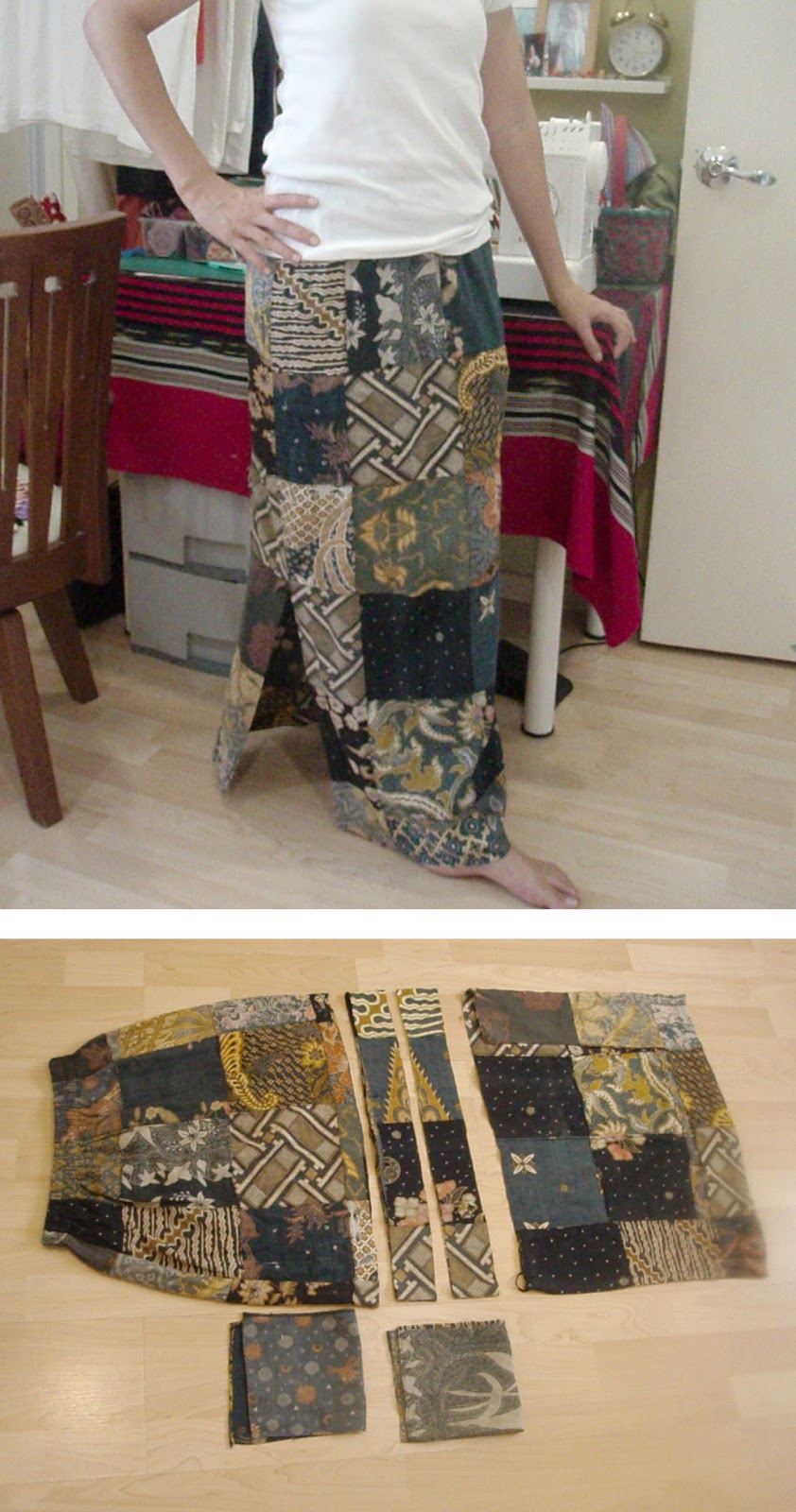
I love batiks. I found all of them unique regardless of their origin. I realised they are distinctive and beautiful in their very own forms. I have a skirt made with beautiful patched old batik Solo. The problem of seasoned fabric is they do not last long as the fabric is somewhat fragile. I had mended a few tears and continued to use it for short while before a bad rip developed on the skirt and I had to give up wearing it.

As usual, I kept it at a corner for awhile. Until one day, I took it out and decided to transform it into a skirt with crossed straps for my daughter. The bad rip was at the bottom part of the skirt and I trimmed it off to make it into an A-lined knee length skirt.

I love pockets and I thought with the crossed straps, the skirt would look cute. I cut the fabric as shown on the picture on the right. The top part of the skirt was cut into the length right on my daughter's knee; the two bands for the straps; from the bottom part of the skirt, I cut off some fabric for the pockets. It was a quick job as there were only minor adjustments.


After


My old torn skirt was given a new life. Zen looks just great in it!

Wednesday, January 12, 2011

Little Artists of Sapa


Standing in front - Anh , Back - Chi

I met Anh aged 10 and Chi aged 13 at Sapa town, Northern Vietnam in 2009. When my friends and I were looking for a cafe to take a rest, I met two Hmong girls dressed in factory-made Hmong costumes with elaborate machine stitched laces by the walkway. They were not the usual Black Hmong but probably white Hmong from or around Tamduong.

They came to a shop front with a narrow platform. Anh took out her lined exercise book from her sling bag and started drawing with her blue ball pen. She used the platform as her table as the shop was built on the slope that was raised above the road. I was attracted by them, especially Anh who was so engrossed with her drawing. Being an artist myself, I always get attracted to kids' natural talent to draw and paint. I gave her the remaining box of crayons which my friend Pam had prepared to give away on the trip. We would usually bring along gifts for children on our travelling and it was a joy to see Anh and Chi so jubilant with having added crayons.

Anh happily filling in colors on her drawing

While my two friends, Pam and Subra, were having beer, I found pleasure in spending time with the girls. Anh was able to converse in simple English and both of them could write their names in English. I believe that they learnt English in school. Anh was confident and wise beyond her years. If she is given opportunity in learning, she could have great achievement in future.

The two paintings given to me by Anh & Chi

I drew a drawing for her and they each drew a painting for me. Anh also gave Pam and another tourist each a painting. I was touched by her generousity. I treasure the two drawings very much and I hope to see them again when I visit their homewon again.

Tuesday, January 4, 2011

Handmade Notebook

I love notebooks and especially those with fabric covers. I use them as travel journals. I would record my experience from trip planning, during the trip and after the journey.

I made two notebooks not too long ago...or more correctly last year since today is January 1, 2011. I took a study of the construction of notebook with fabric cover before I customized my notebooks in my own designs. The toughest part of the process was stitching up the papers. It requires lots of patient and time to accomplish the process.

I have been working a lot with fabrics made by the ethnic minority people of the Golden Triangle and China. For a change, I decided to use Malaysian batik with Borneo ikat motives for my first notebook. I will try to write Chinese in these tiny little squares....


With the snap button, the notebook could hold extra materials, such as brochures.

Right after the first notebook was completed, I couldn't wait to make my second notebook. I decided on an Oriental Theme for my second attempt. I got the idea from a Chinese brass frame hook in my drawer. The hook was in shiny gold when it was new. Over the years, it tarnished and looks even prettier now. The brass frame hook will served as a lock for the notebook. It will be attached onto the magnets hidden beneath the red fabric on the cover of my notebook.

The red cloth I used to make the notebook shown below was given by a friend who runs a business of curtain making and upholstery. I was fortunate to collect fabric remnants from his workshop for free! I made a reversible tote bag and another notebook with the same material.

Front View                                                              Back View

I ran the geometry patterns on the fabric with a sewing machine. Then I stick two small magnets onto a cardboard, which will be used as the front cover of the notebook, before I glued the red fabric on it. Prong snap buttons were used to secure the red band that holds the metal hook. I used white glue and double sided tape for this project.


Left: A Chinese fabric being stitched onto paper.  Right : Plain paper for the insert.


It was a 2 day project which can be done over the weekend. I just can't wait to use the oriental theme notebook for coming trip to China!